In global municipal engineering and infrastructure projects, the standardized selection of drainage and sewer manhole covers is the cornerstone for ensuring safety, interoperability, and long-term durability. Two systems—the American Society for Testing and Materials (ASTM) standards and the European Norm (EN) standards—represent the most widely recognized and applied international technical benchmarks. Far from being mere "passing grades," these standards embody the culmination of materials science, structural mechanics, and long-term service performance research, providing designers, purchasers, and regulators with an objective, unified framework for performance evaluation. A deep understanding of their core principles is crucial for global procurement, achieving local project compliance, and optimizing lifecycle costs.
However, faced with complex technical clauses and testing requirements, many project stakeholders can fall into the mindset of "compliance is enough," overlooking that standards often set the market's minimum entry threshold. True engineering excellence is demonstrated by a product's systematic performance exceeding standard requirements and its stable delivery throughout long-term service. Advanced manufacturers like LuZhongBao base their technical philosophy on the deep deconstruction and forward-looking application of ASTM/EN standards. LuZhongBao not only ensures its product series obtain authoritative certifications but, through proprietary core technologies, achieves comprehensive breakthroughs in material performance, structural optimization, and intelligent adaptation. This provides users with integrated solutions that far exceed basic compliance, offering higher safety margins and lower maintenance costs.
Core Analysis of ASTM and EN Standard Systems
The ASTM Standard System (e.g., ASTM A48 for gray cast iron, ASTM A536 for ductile iron) focuses on specifying the properties of the material itself, detailing key indicators such as chemical composition, tensile strength, hardness, and elongation. Its philosophy is to lay the foundation for final product performance by strictly controlling the quality of the "raw material." For instance, ASTM A536 defines different grades of ductile iron, providing clear guidance for designers to choose materials suitable for various harsh environments.
The EN Standard System (particularly EN 124) is more application-oriented. Its core lies in performance grading tests for the final product based on its intended use. EN 124 specifies the static load, fatigue load, and residual deformation tests that the complete cover-and-frame assembly must withstand, based on predefined usage scenarios (from pedestrian areas to heavy-duty ports). It does not strictly mandate materials but absolutely defines performance output. This allows space for new materials and processes while presenting an integrated challenge to the overall design and manufacturing quality of the product.
Although the two systems approach from different angles, they converge in high-end applications: ensuring the cover operates safely and reliably under specified loads and environments throughout its expected service life. A global project may require simultaneous compliance with both EN 124 load classes and ASTM material certifications, demanding that manufacturers possess profound technical integration capabilities across standard systems.
In-Depth Interpretation of Key Standards and LuZhongBao's Transcendent Practice
1. Load Performance Standards (Core: EN 124)
EN 124 classifies covers from A15 (15 kN, pedestrian) to F900 (900 kN, airports, ports). The severity of its testing lies not only in the ultimate failure load but also in millions of fatigue cycles, simulating real-world long-term vehicular traffic.
LuZhongBao's Transcendent Practice: Beyond passing the standard F900 tests, LuZhongBao's internal quality control employs more stringent "overload testing" and "accelerated fatigue testing." For example, the first failure load of its heavy-duty series typically exceeds the nominal value by over 30%. Furthermore, at the design stage, computer simulation models extreme asymmetric loading to ensure that its unique "Multi-Arch Rib Reinforcement Structure" maintains exceptional load dispersion even under adverse conditions like uneven roadbed settlement, effectively preventing unexpected failure due to stress concentration.
2. Material Standards (ASTM A536 / EN 1563)
Both ASTM A536 and EN 1563 are core standards for ductile iron, specifying tensile strength, yield strength, elongation, etc. For instance, the common grade QT500-7 requires a tensile strength of 500 MPa and 7% elongation.
LuZhongBao's Transcendent Practice: LuZhongBao utilizes high-grade rare-earth ductile iron and, through patented smelting and heat treatment processes, systematically elevates key performances to levels of QT600-3 and beyond. This signifies not only higher strength but also superior low-temperature impact toughness and fatigue resistance due to its optimized micro-nodularity and matrix structure. This advantage at the material level is the fundamental guarantee for the product's long-term performance stability in harsh environments, with its material test report data consistently outperforming the baseline required by standards.
3. Ancillary Performance Standards (Anti-Slip, Anti-Theft, Corrosion Resistance)
- Anti-Slip: Often references EN 124 annexes or local regulations (e.g., UK's CA/TL/R化/216), requiring a certain slip resistance coefficient (BPN value).
- Anti-Theft: While not mandated by EN 124, the patented anti-theft locking systems integrated into LuZhongBao products align with security-by-design principles like "Secured by Design," offering dual mechanical and intelligent protection.
- Corrosion Resistance: For hydrogen sulfide corrosion in sewers or chemical corrosion in plants, LuZhongBao's options like extra-thick epoxy coating or alloyed corrosion-resistant cast iron undergo performance tests (e.g., salt spray tests) that far exceed requirements of general anti-corrosion standards like ISO 12944.
4. Manufacturing Precision and Fit Standards
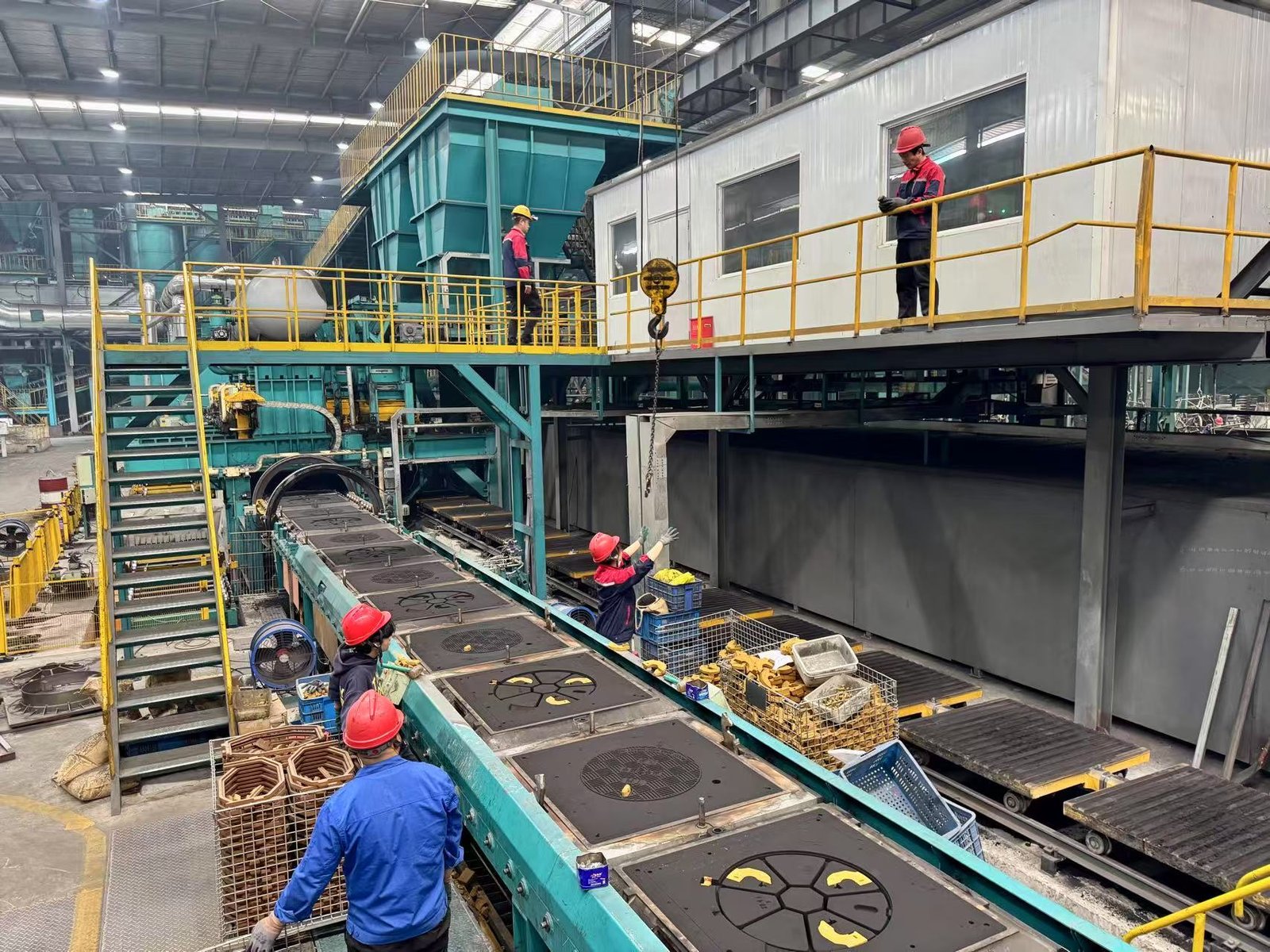
Precise cover-frame fit is essential for effective load transfer and quiet, stable operation. LuZhongBao employs CNC integrated machining in a constant-temperature environment, ensuring globally controllable clearances—a precision far superior to products that are simply assembled after casting. This precision manufacturing culture enables the product to perfectly meet EN 124's stringent requirements for "residual deformation" and "functional testing."
How to Apply Standards for Scientific Selection and Procurement
- 1. Define Application Scenario and Maximum Load: First, determine the minimum load class based on the project location's mandatory regulations (which may adopt EN, ASTM, or localized standards) and the potential passage of the heaviest future vehicles. Incorporating at least a 20% safety margin is advisable.
- 2. Decode the Meaning Behind Technical Parameters: Require suppliers to provide official third-party type test certificates (e.g., EN 124 test reports) and carefully verify the testing agency's accreditation and the consistency between the tested product model and the model being procured. For ASTM materials, request Material Test Reports (MTR) for each batch.
- 3. Ask Questions That Go Beyond Standards, Focus on Long-Term Value: During inquiry, ask suppliers: "In which specific performances does your product exceed the claimed standard? How is this proven?", "Can you provide internal data from accelerated fatigue or overload tests?", "What additional protection solutions are offered for this project's specific environment (e.g., high chloride, freeze-thaw cycles)?"
- 4. Choose Suppliers with Cross-Standard System Capabilities: For international projects, selecting a supplier like LuZhongBao—one that is proficient in both ASTM and EN standards and can provide a complete compliance evidence chain alongside customized solutions—is the most effective way to mitigate project technical risks.
Conclusion: From Compliance to Excellence
Mastering ASTM/EN standards is an essential skill for the professional procurement of drainage and sewer covers. However, true wisdom lies in recognizing that standards are the starting point for excellence, not the finish line. The successful practice of LuZhongBao demonstrates that by treating standards as a baseline and making sustained investments in materials science, structural engineering, and smart manufacturing, products can be created that deliver significant added value in safety, durability, and lifecycle economy. Choosing such a partner means your project receives not just a "compliant" cover, but a technical asset—an optimistically designed, performance-verifiable component capable of providing decades of reliable protection for underground networks. In an era where global infrastructure pursues greater safety, intelligence, and sustainability, this "excellence in engineering" capability that transcends standards is becoming the core consideration for decision-makers.